
St Petersburg oil facility attack: overnight strikes hit Russia
Published October 18, 2026 · 11:34 PM
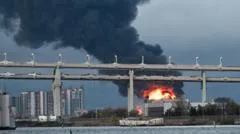
An overnight drone attack in St Petersburg hit two oil facilities, a VKontakte data centre, and an Ozon logistics hub, causing casualties and fires.
What was the impact of the St Petersburg oil facility attack?
The overnight drone strikes in St Petersburg caused significant damage to both energy infrastructure and civilian-adjacent commercial hubs. Governor Alexander Beglov confirmed that fires broke out at the St Petersburg Oil Terminal and the Ruchyi oil depot, necessitating active firefighting efforts. The human cost included at least one fatality and five injuries resulting from the strikes.
Beyond the immediate energy sector, the attack reached into the digital and logistical heart of the region. A data centre belonging to VKontakte, the Russian social network often described as the domestic equivalent of Facebook, was targeted. While VK confirmed the strike, the company stated that its services remained available despite reports of early-morning outages. Similarly, the logistics centre for Ozon, a major Russian e-commerce platform, was hit by a drone, resulting in a fire and the evacuation of staff. While Ozon reported no injuries, the facility has ceased accepting shipments from sellers at that location to focus on other operational needs.
Damage to civilian infrastructure and services
The disruption extended into the daily lives of St Petersburg residents. Governor Beglov reported that 12 apartment buildings and two private homes sustained damage during the strikes. Furthermore, Pulkovo Airport was forced into a temporary closure to manage the security situation. The Governor also warned that residents might experience disruptions to mobile internet services, reflecting the systemic nature of the drone-led assault.
How has the energy war between Ukraine and Russia escalated?
Both nations are increasingly targeting energy infrastructure as they approach the winter months in the fifth year of the full-scale invasion. President Volodymyr Zelensky reported that Russia has targeted the Ukrainian energy sector 76 times since the declaration of an "energy ceasefire" by Donald Trump last week. The scale of Russian aerial activity is massive; Zelensky stated that in the past week alone, Russia launched nearly 2,700 drones, 1,700 aerial bombs, and 66 missiles, most of which were aimed at energy facilities.
Ukraine has also shifted its focus toward disrupting the Russian economy through strategic strikes. This includes targeting oil facilities to limit Moscow's primary revenue stream and launching attacks against Yandex, Russia's largest search engine, which caused service disruptions earlier this month. This cycle of attrition is intensifying as both sides attempt to weaken the other's capacity to sustain the conflict through the cold season.
What is the role of the US-Russia diesel deal in this conflict?
The geopolitical landscape has been complicated by a controversial agreement involving the United States and Russia regarding diesel supplies. President Donald Trump brokered a deal to import Russian diesel to combat skyrocketing US energy prices caused by the ongoing Iran war. This decision has significantly strained relations between Washington and Kyiv, with President Zelensky suggesting that the deal effectively constitutes US investment in the Russian war effort.
The deal also led to a temporary pause in Ukrainian strikes on Russian oil facilities. Ukraine had initially suspended its attacks for three days following the announcement of the "energy ceasefire," but subsequently resumed strikes earlier this week. This resumption drew criticism from Trump, who sought a truce to facilitate the diesel supply agreement. The decision to temporarily suspend certain sanctions against Russia has also faced backlash from members of the US Republican party.
Diplomatic communications amid rising tensions
Despite the friction, diplomatic channels remain open. Zelensky noted on Telegram that he has been in contact with Trump's top negotiators, Steve Witkoff and Jared Kushner. According to Zelensky, their respective teams are maintaining constant communication to prepare for the next diplomatic steps in the conflict.
How are civilians being affected by the intensifying strikes?
The human impact of the energy war is becoming increasingly severe as winter approaches. In Ukraine, Russian strikes on energy infrastructure have left hundreds of thousands of people without power. Zelensky highlighted that tens of thousands of citizens remain in the dark, raising urgent concerns about the ability of the population to endure freezing temperatures.
The United Nations has also flagged the rising civilian toll. On Friday, the UN noted that the first two weeks of October had been among the deadliest for Ukrainian civilians in recent years. While Russia maintains that its strikes are directed at targets used by the Ukrainian military, the collateral damage to civilian life remains a central concern for international observers.
Frequently asked questions
What specific facilities were hit in St Petersburg?
The attack successfully targeted the St Petersburg Oil Terminal and the Ruchyi oil depot. Additionally, a logistics centre owned by the e-commerce company Ozon and a data centre belonging to the social network VKontakte were also struck by drones during the overnight operation.
How has the US energy policy impacted the conflict?
The US decision to import Russian diesel to lower domestic energy prices has created tension with Ukraine. President Zelensky has argued that this deal, brokered by Donald Trump, indirectly supports Russia's military capabilities by providing them with essential revenue and economic stability.
Has Ukraine commented on the St Petersburg attack?
As of the latest reports, Kyiv has not yet issued an official comment regarding the specific strikes on the St Petersburg oil facilities and logistics centres. However, Ukraine has been actively resuming strikes on Russian energy infrastructure following a brief pause.
What is the current status of Pulkovo Airport?
Pulkovo Airport was temporarily closed following the drone attacks in the St Petersburg region. The closure was part of the immediate response to the security threat posed by the incoming drones and the subsequent fires in the city.
How many drones did Russia launch recently?
According to President Zelensky, Russia launched nearly 2,700 drones, 1,700 aerial bombs, and 66 missiles in the past week. The majority of these munitions were directed at energy-related targets to disrupt the Ukrainian power grid.
Key takeaways
- The St Petersburg attack hit two oil depots, an Ozon logistics hub, and a VKontakte data centre.
- At least one person was killed and five were injured during the overnight drone strikes.
- The US-Russia diesel deal has caused significant diplomatic friction between Washington and Kyiv.
- Russia's recent aerial campaign included nearly 2,700 drones and 1,700 aerial bombs.
- Energy infrastructure strikes are leaving tens of thousands of Ukrainians without power ahead of winter.
Conclusion
The strike on St Petersburg represents a significant escalation in the broader war of attrition targeting energy and digital infrastructure. As both Russia and Ukraine intensify their drone and missile campaigns, the focus on economic and logistical hubs like oil depots and data centres highlights a strategy aimed at long-term destabilization. The intersection of these military actions with complex US energy politics and the looming winter season creates a precarious environment for civilians on both sides. While diplomatic channels remain active, the immediate reality is one of increasing physical and economic disruption.
